Writeless AI promises to turn a topic into a complete academic paper with citations, but I was more interested in what happens between entering an assignment and getting something useful. A finished essay means little if the argument is weak, the references are unreliable, or half the content needs rewriting.
What makes Writeless interesting is that it combines essay generation with research tools, citation formatting, and the option to add supporting documents. Its approach is convenient, although the quality of the final paper still depends on how well the supplied information is interpreted.
Starting With Writeless AI
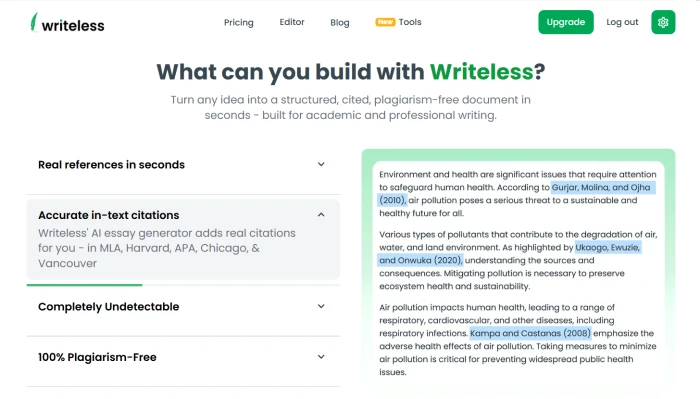
Writeless AI is an academic writing platform for generating essays, research papers, literature reviews, and other structured documents. Its central feature is an AI essay writer that incorporates references and supports APA, MLA, Harvard, Chicago, and Vancouver citation styles.
The platform also provides a Research Assistant, Reference Finder, Bibliography Generator, AI Summarizer, and AI Humanizer. These tools address different parts of preparing academic work rather than focusing exclusively on generating text.
The essay-writing interface is particularly interesting because it supports more than entering a topic. It also offers options to add PDF files and images, giving users a way to supply supporting material alongside their instructions.
I focused on a typical university assignment requiring an argument, academic references, and a specific writing structure. This is a more meaningful benchmark than asking the system to generate a general article on a familiar subject.
Setting Up The Essay
The assignment I chose as my benchmark was a 1,500-word argumentative essay about the relationship between social media usage and university students' academic performance.
I used the following brief to define what the paper needed to cover:
Essay prompt: “Write a 1,500-word argumentative essay examining whether social media improves or harms university students' academic performance. Discuss attention, study habits, academic collaboration, and the differences between recreational and educational use. Include relevant research, opposing arguments, and APA 7 citations.”
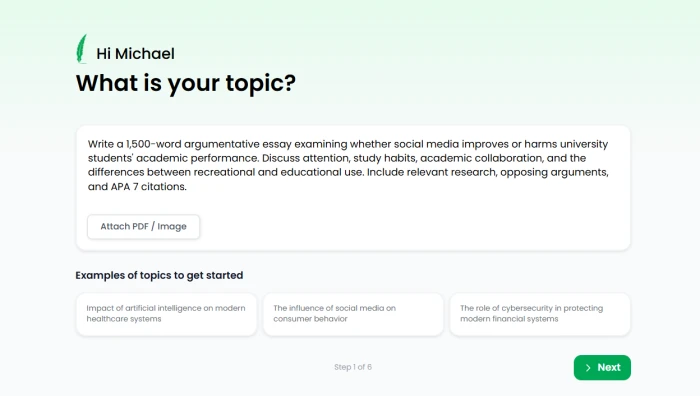
This topic demands a more developed argument than simply listing advantages and disadvantages. The essay needs to explain how different types of social media activity affect learning rather than assuming that all online activity produces the same outcomes.
Writeless's guided workflow is designed to handle the assignment instructions and citation format together. This is more convenient than building a document through several disconnected chatbot prompts.
I also paid attention to the document-length options. The website advertises essays reaching 20,000 words on paid plans, although a higher word limit is useful only when the writing maintains sufficient detail and avoids repetition.
For shorter university assignments, I would prioritize meeting the requested structure and developing each argument properly rather than generating unnecessary paragraphs to reach a larger word count.
Adding PDFs And Images
One useful detail about Writeless's essay interface is the option to attach PDF documents and images. This matters because academic assignments often arrive with supporting material rather than a simple written topic.
A PDF might contain an assignment brief, a journal article, lecture notes, or a reading supplied by an instructor. An image might contain a chart, a screenshot of assignment instructions, or a diagram relevant to the subject.
For the social media assignment, suitable supporting material would include a PDF research paper discussing digital multitasking and an image containing a chart of student study behaviors. These attachments give the writing task more context than the topic alone.
However, attaching a document is different from establishing that every detail inside it has been interpreted correctly. The important distinction is whether the generated text accurately reflects the source material.
A PDF containing research findings needs to be treated as evidence, not simply additional text to paraphrase. Similarly, an uploaded chart should be interpreted using its actual labels, measurements, and limitations.
I would pay particular attention to three points:
● PDF interpretation: Research findings should retain their original meaning, including qualifications, publication details, and numerical results.
● Image understanding: A chart or diagram should be described accurately rather than used as a reason to introduce unsupported statistics.
● Source attribution: Information taken from uploaded documents should be distinguishable from additional material generated by the AI.
The upload feature is useful because it expands the type of information that can accompany an assignment. Its real academic value, however, depends on whether the resulting paper uses those materials accurately.
Reading The Draft
My main concern with Writeless's essay generation is not whether it can produce a formal-looking document. It is whether the paragraphs develop an argument rather than repeat familiar academic statements.
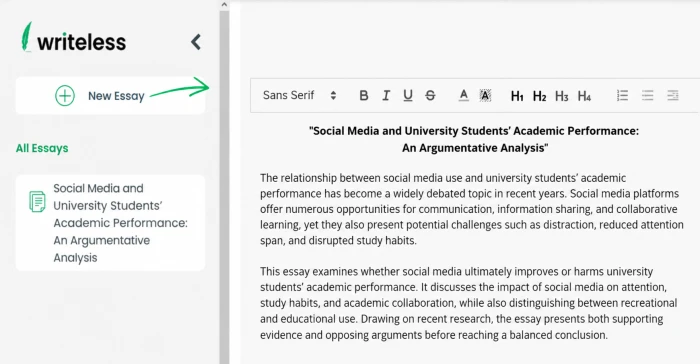
For the social media assignment, the thesis should do more than acknowledge positive and negative effects. It should identify the circumstances under which social media helps or interferes with academic performance.
A defensible position is that the impact depends partly on whether students use social platforms for focused academic collaboration or repeatedly interrupt independent study with unrelated activity. That argument creates a clear direction for the paper.
The section on attention should explain the relationship between notifications, interruptions, and concentration. The discussion of study habits should examine how online behavior interacts with time management. Collaborative learning should be supported by research about communication, resource sharing, and student participation.
These distinctions matter because generated academic writing can become repetitive even when every paragraph is grammatically correct. A paragraph stating that social media creates distractions does not add much unless it explains the nature of those distractions and connects them to a supported academic outcome.
Writeless can assist with building the document's structure, but its final usefulness depends on the substance inside those sections.
Checking The Citations
Citation generation is one of Writeless AI's most heavily advertised features. The platform promotes references from academic sources and automatically formatted in-text citations.
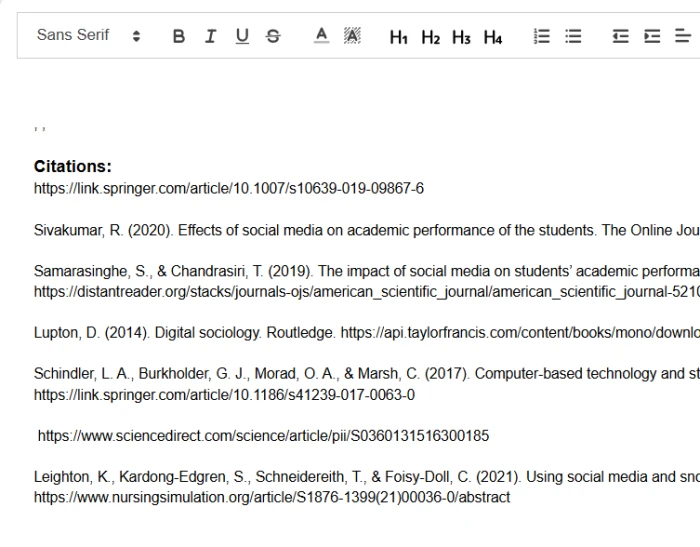
This is particularly relevant because researching an assignment and preparing its bibliography can take longer than writing some of the paragraphs. However, I do not treat a citation as reliable simply because it appears in the correct format.
For the social media essay, a source discussing general online activity cannot automatically establish that social media causes lower university grades. The paper must actually investigate the relevant behavior and outcome.
I organized the citation requirements into a simple checklist.
| Citation detail | What matters |
| Source authenticity | The cited publication must exist |
| Author and year | Details should match the original paper |
| Evidence relevance | The findings must support the attached claim |
| Research interpretation | Correlation should not become a causal claim |
| APA formatting | In-text citations must match the reference list |
Writeless advertises real academic references, but the platform's marketing does not independently establish that every generated citation is accurate. The most important check is whether the cited study supports the particular argument being made.
For example, research about students' average screen time should not be used as direct evidence of reduced academic achievement unless the study actually measured that relationship. This is where academic source verification remains essential, regardless of how polished the bibliography looks.
Exploring The Research Tools
Writeless provides several additional tools that support different stages of writing. I find the research-oriented features particularly relevant because they address tasks that happen before drafting and during revision.
The Research Assistant accepts academic questions and provides sourced responses. Its interface includes an option to add references and supports citation formats including APA, MLA, Harvard, Chicago, and Vancouver.
For the social media assignment, a focused question is:
"What does academic research suggest about the effects of social media multitasking on university students' attention and learning outcomes?" This is more useful than asking whether social media is harmful because it narrows the question to a specific behavior and measurable consequences.
The Reference Finder is intended to locate relevant sources, while the Bibliography Generator focuses on organizing references into the required format. The AI Summarizer provides another useful function by condensing lengthy articles or research material into shorter explanations.
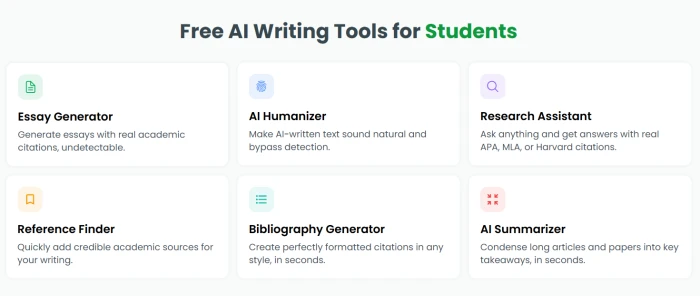
These features serve different purposes, and I would not treat them as interchangeable.
| Writeless tool | Practical purpose |
| Essay Generator | Creates structured academic drafts |
| Research Assistant | Explores questions with supporting references |
| Reference Finder | Locates relevant academic sources |
| Bibliography Generator | Formats reference lists |
| AI Summarizer | Condenses lengthy reading material |
| AI Humanizer | Rewrites text in a more natural style |
| AI Detector | Evaluates text for AI-writing indicators |
The main advantage is that these tools address several connected tasks within the same service. However, research summaries and generated citations still need to be checked against the original publications, especially when numerical findings or technical conclusions are involved.
Revising The Writing
The next important consideration is how much work a generated academic draft still needs. For an argumentative essay, I would concentrate on paragraph development, factual accuracy, and unnecessary repetition before making stylistic changes.
The first editing priority is the thesis. A general statement about social media having benefits and disadvantages needs to become a claim that the essay actually defends.
Next comes the supporting evidence. Each substantial research claim should have an appropriate source, and the discussion should explain how that evidence contributes to the argument. I would also remove paragraphs that repeat similar points using different academic phrases.
For example, a sentence such as "Social media has significant implications for contemporary educational performance" provides little usable information. It is better to explain the specific behavior and academic outcome under discussion.
The AI Humanizer offers a separate rewriting option intended to make generated text sound more natural. Writeless advertises this feature partly through claims about avoiding AI detection. I would approach those promises cautiously because detector results are not reliable guarantees of authorship or originality.
More importantly, changing the wording cannot correct an unsupported argument. Research accuracy should come before stylistic polishing.
Reaching The Paywall
Writeless advertises one free essay generation, but its official pricing page describes that access as preview only. That distinction is important because evaluating the document's overall appearance is different from working freely with a completed paper.
The paid plans advertise unlimited essay generations, up to 20,000 words per essay, and up to 20 citations per document.
Here is the pricing published in October 2026:
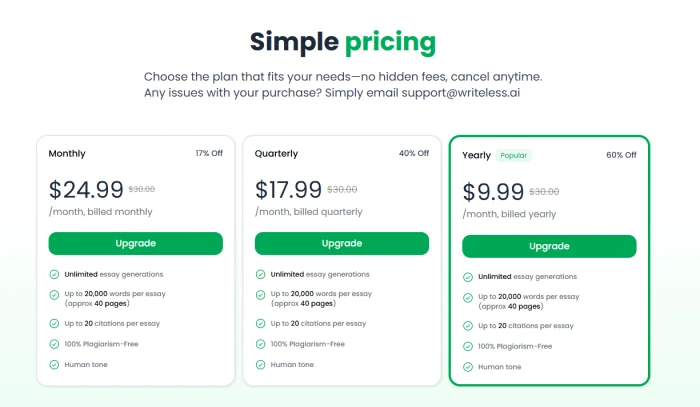
The annual option reduces the effective monthly cost, but it requires $119.88 upfront. The quarterly plan totals $53.97 every three months. For occasional academic writing, I would prefer the monthly membership over making an annual commitment before establishing how useful the platform is.
Another consideration is whether access to supplementary tools is included in the selected subscription. The essay-writing allowance should not automatically be interpreted as unlimited usage of every tool.
I would also review renewal terms and cancellation conditions before paying, especially given public customer complaints about billing and access to certain features.
What Worked Best
Writeless's strongest selling point is its academic-specific approach. The essay generator is built around assignments, citation formats, and longer documents rather than generic conversational responses.
The PDF and image upload options make the workflow more relevant to assignments that include reading material, charts, or instructor instructions.
I also like the separation between generating an essay and working with references. Academic writing usually requires both activities, and the Research Assistant, Reference Finder, and Bibliography Generator provide dedicated tools for them.
The main advantages are:
● The guided essay workflow allows academic requirements and citation formats to be specified together.
● PDF and image attachments make it possible to provide supporting material alongside the written assignment.
● Research and reference tools cover tasks that normally require moving between different services.
● The advertised long-form allowance supports substantial papers rather than only short essays.
However, the platform still leaves several important responsibilities with the writer. Source accuracy needs independent checking, academic arguments may require revision, and the free preview does not provide unrestricted access to the finished document.
Where It Falls Short
The main weakness is the gap between producing a complete-looking academic document and establishing whether the document is academically reliable. Writeless advertises citation-ready papers, but automatically generated references are not equivalent to verified research.
The free access is another restriction. A preview can show how the system structures an essay, but it offers less opportunity to inspect and revise the complete work before purchasing.
I also find the platform's emphasis on undetectable AI writing less useful than its research features. An undetectability claim does not demonstrate that the writing is accurate, original, or suitable under an institution's academic integrity rules.
The most significant limitations are:
● References still need to be verified against original academic publications, even when they are automatically formatted.
● Generated arguments may require substantial editing to remove repetition and unsupported claims.
● The preview-only free plan limits how thoroughly users can assess the complete document.
● Subscription terms and supplementary feature access require careful checking before payment.
These limitations matter most when the essay contains detailed evidence, technical research, or assignment-specific instructions that cannot be handled through generic academic writing.
My Final Assessment
Writeless AI offers a useful collection of tools for preparing academic drafts, especially when an assignment includes citation requirements and supporting documents.
Its essay generator provides a structured starting point, while the research and bibliography tools address other parts of the writing process. The ability to add PDFs and images also makes the workflow more relevant to assignments built around existing reading material.
I would use the platform primarily for organizing an initial draft, exploring research questions, and preparing references for further verification.
The main reservation is that its advertised convenience should not be confused with guaranteed academic accuracy. Source checking, editing, and interpretation remain necessary even when the generated document looks complete.
Verdict: Writeless AI is worth considering as an academic drafting assistant, particularly for users who want essay generation and research tools together. Its value depends on how effectively those tools reduce preparation work, while the responsibility for accurate evidence and a convincing final argument remains with the writer.