A keyword isn’t a topic. It’s a question with an expectation attached and your job is to figure out the expectation before you write a single line.
Most people who sit down to write around a keyword do the same thing: they treat the phrase as a subject to be covered. Type “meal prep for weight loss,” scatter it through some headings, pad it out to a respectable length, hit publish. Then they wonder why it never ranks, or why it ranks for a week and quietly slips.
The problem isn’t the writing. It’s the assumption underneath it. This guide walks through how to read what a searcher actually wants, and how to build a post that answers it so completely they stop looking.
A keyword is a question in disguise
Nobody searches for a keyword. They search with one. Behind every phrase typed into a search box is a person in a specific moment, carrying an unspoken expectation about what a good answer looks like. The keyword is just the compressed version of that moment.
Look at two phrases from the same corner of the internet:
● “best running shoes” this person is comparing, probably close to buying, and wants opinions, shortlists, and a reason to trust one pick over another.
● “how to lace running shoes” this person owns the shoes already and has a small, specific problem to solve in the next two minutes.
Same domain, same product, completely different reader. Give the second person a buying guide and they leave immediately. Match the words and miss the person, and you’ve written nothing useful. Everything else in this article is about closing that gap.
Covering a Topic Isn’t Answering a Query
When a keyword-driven post fails, it usually fails for a reason you can name. It’s rarely bad grammar or thin effort. It’s a mismatch between what the writer decided to say and what the reader arrived hoping to find.
A few patterns show up again and again:
● Treating the keyword as a promise you never keep. The title says “quick weeknight dinners” and the post opens with 500 words on the history of home cooking. The reader wanted dinner by Tuesday, not a preamble.
● Matching the words but not the meaning. You mention “meal prep for weight loss” eleven times, but every section is a generic recipe with no calorie logic, no portioning, no answer to the actual weight-loss part.
● Answering the intent you wish they had. Someone wants a straight comparison of two tools; you’d rather write a philosophical piece about why tools don’t matter. That’s your agenda, not their question.
● Writing for the algorithm instead of the arrival. The post is engineered to look complete to a crawler and feels hollow to a human ten seconds in.
A keyword is not a subject to cover. It’s a promise to fulfil and the reader decides whether you kept it.
The four everyone teaches and the fifth they skip
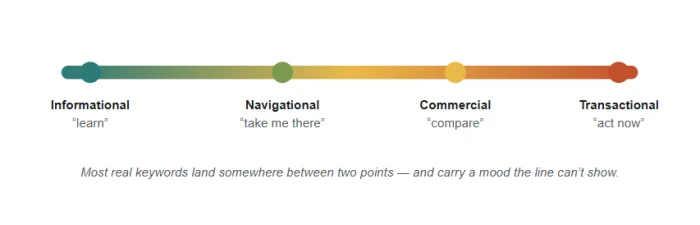
Search intent gets sorted into four buckets, and they’re a fine starting point. Someone wants information, wants to reach a specific place, wants to weigh options, or wants to complete an action. Here’s how those play out.
| Intent | What the reader wants | Example phrase |
| Informational | To understand or learn something | how does meal prep help weight loss |
| Navigational | To get to a known place or brand | MyFitnessPal login |
| Commercial | To compare before deciding | best meal prep containers |
| Transactional | To act, buy, or sign up now | order meal prep delivery |
The trouble is that real searches don’t stay in one box. “Meal prep for weight loss” is mostly informational, but a slice of that audience is also shopping for containers and comparing delivery services in the same sitting. That’s mixed intent, and it’s the rule, not the exception.
And there’s a layer underneath all of it that the standard four ignore entirely: the emotional and situational state of the searcher. Two people can type the exact same phrase from opposite mindsets.
● Urgency: someone who just committed to a diet on Sunday night needs to prep tomorrow. They want a plan they can start now, not a nuanced discussion of macronutrient theory.
● Skepticism: someone who’s tried and failed before is quietly asking “will this actually work for me, or is it another thing I’ll abandon in three weeks?”
● Overwhelm: someone new to all of it doesn’t want twelve options they want one confident path and permission to stop researching.
You can’t read that layer off the keyword alone. But once you know it’s there, you start writing to a person instead of a phrase and that’s the difference between a post that ranks and a post that gets remembered.
The results page is a confession
Here’s the shortcut nobody should skip: before you decide what your post is, search the keyword yourself and study what’s already ranking. Google has spent years and billions of clicks learning what satisfies each query. The current page one is its best answer to the question “what did people actually want here?”
So read it like a blueprint. For “meal prep for weight loss,” you might notice the whole first page is step-by-step guides with sample plans and photos, no product pages, no thin definition posts. That tells you something before you’ve written a word.
| What you see on page one | What it’s telling you to do |
| Every result is a listicle | Readers want scannable options, not one long essay |
| Long, in-depth guides dominate | The topic has real weight; a short post won’t satisfy it |
| A “People Also Ask” box with 4–6 questions | The follow-up questions you’ll need to answer inside the post |
| A featured snippet pulled from a definition or list | The exact format Google wants that answer served in |
| Videos or images ranking high | People want to see this, not just read it |
| Big brands and forums mixed together | Readers trust lived experience here, not just authority |
None of this means you copy the top result. It means you learn the shape of a satisfying answer, then decide how to fill that shape better than anyone currently on the page.
Three Questions to Understand Intent
“Match the intent” is advice everyone repeats and few explain. Here’s a way to make it concrete. Before writing, answer three questions about the person behind the keyword. They take five minutes and they change everything downstream.
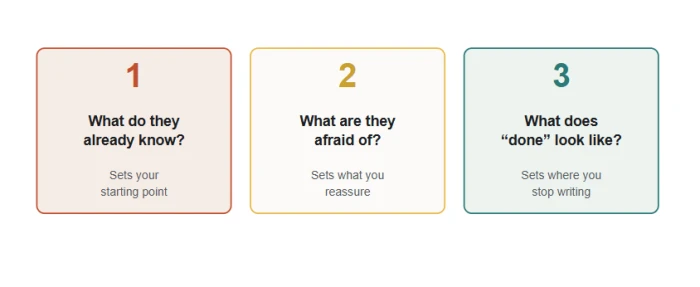
What do they already know?
This sets your entry point. If someone searches “meal prep for weight loss,” they know what meal prep roughly is, so opening with a dictionary definition wastes their time and signals you don’t understand them. Start where their knowledge ends, not where a textbook begins.
What are they quietly afraid of?
Every query has a fear behind it. Here it’s usually “this will be bland, expensive, and I’ll quit by Wednesday.” Name that fear and answer it, and you build trust no competitor bothered to earn.
What does “done” look like for them?
This is your finish line. For this reader, “done” is having a realistic plan they can start this week without a chef’s skillset. Every section should push toward that outcome. When they have it, your post is finished not a word sooner, not a word longer.
Intent Gets You In, Angle Makes You Memorable
If ten posts already match the intent perfectly, matching it an eleventh time makes you interchangeable. Google has no reason to rank a copy, and readers have no reason to remember one. So after you understand the intent, find the gap the current page leaves open.
Read the top results with a critical eye and look for what they all skip:
● The assumption they all make. Maybe every meal-prep guide assumes you have three free hours on Sunday. Your angle: prep for people who genuinely don’t 30 minutes, done.
● The audience they ignore. Everyone writes for solo dieters; nobody writes for someone cooking for a skeptical family too. That’s an open lane.
● The honesty they avoid. Most guides pretend it’s easy and fun. Admitting the boring parts and solving them reads as trustworthy precisely because it’s rare.
● The depth they stop short of. They list meals; you explain the portion logic so the reader can build their own forever. That’s the difference between feeding someone once and teaching them to cook.
The angle doesn’t change the intent you still answer the question they came with. It changes whether yours is the answer worth keeping.
Build the Structure Around the Reader
Once you know the intent and your angle, the outline almost writes itself because a well-ordered post mirrors the reader’s own mental journey. They arrive with a sequence of unspoken questions, and your headings should answer them in the order they’d naturally ask.
For “meal prep for weight loss,” the reader’s internal script runs roughly like this:
● “Will this actually help me lose weight?” → a short, confident section on why prepping controls portions and cuts impulse eating.
● “How much do I eat, then?” → simple portioning logic they can apply to any meal.
● “Okay, what do I actually make?” → the sample meals and plans, the meat of the post.
● “How do I keep this up?” → storage, batching, and the tips that stop week two from falling apart.
Notice the order isn’t “whatever I feel like writing.” It’s the reader’s curiosity, sequenced. When structure follows that arc, someone can skim your subheadings alone and still walk away with the answer. That’s not lazy reading it’s a sign you built the thing correctly.
Your Intro Has One Job
The opening isn’t where you warm up. It’s where the reader decides whether to stay, and they decide fast. Someone who landed from search is still half-committed to hitting the back button and trying the next result. Your first few lines either confirm they chose well or confirm their doubt.
A strong intro does two things quickly:
● It proves you understand their exact situation ideally by naming the real problem out loud, the way they’d phrase it themselves. Recognition builds instant trust.
● It promises a specific payoff and hints at how you’ll deliver it so they know the scroll is worth it without you having to say “in this article we will.”
What kills an intro is throat-clearing: the generic backstory, the dictionary definition, the slow ramp before the value. Cut all of it. If your first sentence would fit on a hundred other posts, it’s not doing its job.
Match the Question, Not a Word Count
The advice to “write 2,000 words to rank” is one of the most expensive myths in this field. Length is a byproduct of doing the job fully, never the goal. Some questions deserve a paragraph. Some deserve four thousand words. The keyword tells you which.
The real test is whether you’ve exhausted the intent, not whether you’ve hit a number. Ask yourself:
- Have I answered the core question so completely the reader has no reason to open another tab? If yes, more words only get in the way.
- Am I adding this section because the reader needs it, or because I’m padding toward a target? Padding is obvious, and it’s the fastest way to lose someone.
- Would a knowledgeable friend consider this thorough, or thin? That instinct is more reliable than any word-count plugin.
A tight 900-word post that fully answers a simple query will out-rank and out-last a bloated 3,000-word one every time. Depth means covering what matters completely. Length is just what happens along the way.
Answer the Next Question Too
A truly complete post handles the follow-up questions a reader has the moment your main answer lands the ones that would otherwise send them back to search. The “People Also Ask” box and the related searches at the bottom of the results page hand you these for free.
For our example, the secondary questions might be how many calories to aim for, which containers keep food fresh longest, and how to stop prepped meals getting boring by day four. Fold those in where they naturally belong.
The balance to hold
Secondary questions support the primary intent; they don’t replace it. If you spend 600 words reviewing containers inside a weight-loss guide, you’ve drifted into a different post and diluted the one you promised. Answer the follow-up briefly, link out to the full piece if you have one, and get back on track.
Done right, this is what makes a post feel complete rather than merely correct. The reader keeps thinking of the next question, and you’ve already answered it a paragraph ahead of them.
Make the Intent Match Clear
Once the content is right, the on-page elements are your chance to make the match legible to both the searcher scanning results and the crawler reading your page. Treat them as evidence of intent-match, not as SEO boxes to tick.
● Title tag: it should promise the exact thing the searcher wants, in language close to how they’d say it. This is your first impression on the results page and it decides the click.
● Meta description: not a keyword dump a two-line pitch that confirms “this post answers your specific question” and gives a reason to choose you over the result above.
● Headings: written so someone can understand the whole post from the subheads alone, which doubles as a map for search engines parsing your structure.
● Internal links: pointing to the related posts a reader would logically want next which keeps them on your site and signals topical depth around the subject.
● Media: the images, tables, or video the SERP told you readers expect placed where they clarify, not decorate.
None of these rescue a post that answers the wrong question. But when the content is right, they’re the difference between a match that’s obvious and one that’s buried.
Rankings Show Reach, Behaviour Shows Fit
You can rank on page one and still be failing the reader. Position is a starting signal, not proof. The real evidence lives in what people do once they land because their behaviour is intent-match, measured.
| Signal | What it suggests |
| Healthy time on page & scroll depth | People are reading, not skimming and fleeing the answer is landing |
| Pogo-sticking (they click you, then bounce back to Google) | You matched the words but missed the intent the clearest failure signal there is |
| Low bounce with onward clicks to related posts | You answered the question and earned enough trust to keep them |
| Conversions or sign-ups (where relevant) | The transactional slice of the audience got what they came for |
The single metric that matters most is invisible in any dashboard: did the searcher stop searching? If they found your post, read it, and never went back to try another result, you matched the intent. Everything else is a proxy for that one thing.
Every post is a hypothesis, not a monument
Here’s the part that’s easy to resist: publishing is the start of the work, not the end. You built the post on your best read of what the searcher wanted. That read was a guess, an educated one, but a guess. The data tells you how close you got.
Intent also drifts. What people expected from “meal prep for weight loss” two years ago isn’t quite what they expect now, and the results page shifts with them. A post that matched perfectly can slowly fall out of sync while you’re not looking.
So treat each piece as something you revisit:
● When it under-performs, re-run the search and check what’s ranking now. The winners are telling you what the intent became while you weren’t watching.
● When behaviour is weak, assume the mismatch is yours before blaming the algorithm then fix the section where readers seem to drop off.
● When it works, study why, and carry that read of the audience into the next post.
The writers who win over years aren’t the ones who guess right once. They’re the ones who keep testing the guess.
Stop writing about keywords, Start answering people.
The whole craft comes down to a single shift in how you see the phrase in front of you. A keyword isn’t a topic to be covered or a word to be repeated until an algorithm notices. It’s a compressed question, carried by a real person in a specific moment, with an expectation they can’t always put into words.
Do the unglamorous work, read the results page, decode what they already know and quietly fear, find the angle nobody else took, and build the post so its very shape answers the question and ranking stops being something you chase. It becomes the natural consequence of having actually helped.
The next time you sit down with a keyword, don’t ask “what can I write about this?” Ask “who typed this, what do they really want and what would make them stop looking?” Answer that, and the post writes itself.