The honest answer isn’t “long” and it isn’t “short.” It’s that length is a lever and most people are pulling it for the wrong reasons. Ask ten marketers whether long-form or short-form content ranks better and you’ll get ten confident answers, most of them contradicting each other, and most of them wrong in the same way. They’re treating word count like a setting you dial in for rankings, when it’s really the leftover result of decisions you make before you write anything.
This piece takes the question apart. Not to crown a winner, but to hand you the three things that actually decide length, and a way to make that call in about two minutes for any piece you sit down to write.
Length is a consequence, not a strategy
“What ranks better” assumes length is a cause of ranking. It isn’t. Nobody has ever climbed the results page because their post crossed 2,000 words, and nobody has been buried for writing 400. Google doesn’t count your words and reward the total.
What it rewards is a page that fully answers the thing someone searched for. Sometimes that answer is a sentence. Sometimes it’s a 4,000-word teardown. The length was never the strategy, it was the shape the right answer happened to take. So the real question isn’t “which is better,” it’s “which fits this job.” The rest of this article is about answering that.
Defining the Terms Without the Arbitrary Count
Somewhere along the way the industry decided long-form means 2,000-plus words and short-form means anything under, and that number has done real damage. It’s made writers pad thin ideas to hit a target and trim rich ones to stay “snappy,” both for no reason a reader would recognise.
A more useful definition ignores the word count entirely and asks about coverage relative to the question:
● Short-form covers one clear thing and gets out of the way a single answer, a quick how-to, one update. It’s built for a query with a finite, knowable end.
● Long-form covers a subject in enough breadth and depth that the reader doesn’t need a second tab; it holds several related questions under one roof. It’s built for a query that opens up rather than closes down.
By that measure a 600-word post can be genuinely long for “how to reset an AirPods pairing” and painfully thin for “how to switch careers into UX.” Same word count, opposite verdicts because length only means something next to the question it’s answering.
The Correlation Trap
You’ve seen the charts: average word count of page-one results climbing with position, the implication being that more words earn better rankings. Those studies aren’t fabricated. They’re just being read backwards.
Here’s what’s actually happening. The queries competitive enough to have those studies run on them tend to be broad, informational, high-stakes topics the kind that genuinely require depth to answer well. On those queries, thorough pages win, and thorough pages are long. Length is riding along with the win. It didn’t cause it.
- The myth : Long content ranks better, so adding words improves your odds.
- The reality : Hard questions need thorough answers; thorough answers happen to be long. The depth ranks the word count is a side effect.
The test is simple: take one of those long ranking pages and cut it to a third without losing any real answer. If you can, the length was padding and it wasn’t helping. If you can’t if every section is load-bearing then the length was never the point. The completeness was.
Word count doesn’t rank. Coverage does. Length is just what coverage weighs.
What Long-Form Actually Does Well
“Comprehensive” is where most explanations stop, which is a shame, because the real advantages of long-form are more specific and more interesting than that. When a long piece works, it’s pulling several distinct levers at once.
● It captures a whole cluster of searches, not one. A deep guide naturally uses the related terms, sub-questions, and phrasings people search around a topic, so it can rank for dozens of long-tail queries a short post would never touch.
● It earns links by being the thing worth citing. Nobody links to a 300-word definition. People link to the definitive resource on a subject, because linking to it makes their own work look thorough. Depth is link bait in the honest sense.
● It holds attention long enough to signal quality. A reader who spends four minutes working through a genuinely useful guide sends a very different behavioural signal than one who bounces in eight seconds.
● It builds the topical authority that lifts everything else. Covering a subject exhaustively tells search engines your site is a serious source on it, which quietly helps your other pages in the same territory.
Notice that none of these are about the words themselves. They’re about what real depth makes possible coverage, citations, trust. The length is the container those benefits arrive in.
What Short-Form Actually Does Well
Short-form gets treated as the lightweight option, the thing you write when you don’t have time for the real work. That’s a misread. For the right job, short is not the compromise it’s the correct answer, and it does things long-form structurally can’t.
● It wins the featured snippet. When someone asks a direct question, Google often lifts a tight, clean answer into position zero. A crisp 50-word definition frequently beats a rambling section buried in a 3,000-word guide.
● It ships fast, which matters when timing is the whole game. For anything news-driven or trending, being first and clear beats being thorough and late. You can always expand it once the moment passes.
● It respects a reader who just wants the answer. Someone whose sink is leaking right now does not want your childhood memory of plumbing. Give them the fix, and the brevity itself reads as respect for their time.
● It travels where long-form can’t. Short content is what actually moves through social feeds, email, and messaging channels Google doesn’t own but your audience lives in. A pithy post gets shared; a 4,000-word guide gets bookmarked and forgotten.
Short-form also carries almost no maintenance debt. A one-answer post about a stable fact can sit untouched for years. That’s a real, underrated advantage we’ll come back to.
Side by Side: An Honest Anatomy
Laid out plainly, the two formats stop looking like competitors and start looking like different tools. You wouldn’t argue about whether a hammer beats a screwdriver.
| Metric | Long-form | Short-form |
| Best at | Depth, topical authority, earning links, ranking for many terms at once | Snippets, speed, clarity, sharing, single-answer queries |
| Weak at | Speed to publish, staying current, mobile skim-reading | Link gravity, covering a subject fully, ranking for broad terms |
| Ideal job | Pillar guides, deep how-tos, comparisons, evergreen references | Quick fixes, news, definitions, updates, decision nudges |
| Maintenance | High ages and needs updating | Low often set-and-forget |
Keep this in mind as we move into the part that actually matters: the three variables that tell you which column you’re in before you write a word.
Variable One: Intent and Query Complexity
The first and biggest factor is how much the question actually contains. Some queries have a floor and a ceiling. There's a right answer and once you’ve given it, you’re done. Others open into a whole landscape the moment you start.
Two quick examples make the split obvious:
● “What year did the euro launch?” has exactly one answer. Wrapping it in 1,500 words of context isn’t thorough, it’s obstruction and Google will hand the snippet to whoever answered it in one line.
● “How do I plan a wedding on a tight budget?” is not one question, it’s twenty stacked into one phrase venues, guest lists, hidden costs, where to cut, where not to. Answer only the surface and the reader immediately leaves for someone who went deeper.
So before anything else, weigh the query. If a knowledgeable person could fully answer it out loud in under a minute, you’re writing short. If they’d need to sit you down, you’re writing long and no styling trick changes that.
Variable Two: Where the Reader Sits in the Journey
The same person wants different lengths at different moments, and where they are in their decision changes what “helpful” means. Length should move with them.
Early on, when someone is still figuring out what they even need, depth is welcome. They're exploring, comparing, learning the shape of the problem. They’ll happily read a long guide because they don’t yet know enough to want the short version.
Closer to a decision, that flips hard. Someone with their card half out of their wallet does not want a 3,000-word essay; they want the one comparison that settles it and a clear next step. Make them read to act and many of them simply won’t.
● Top of the journey (learning): lean long explainers, guides, and overviews that build understanding and trust before any ask.
● Middle (comparing): medium and structured enough to weigh options honestly, organised so they can jump to what they care about.
● Bottom (deciding): lean short a focused answer, a clear recommendation, and an obvious way to move forward.
Variable Three: The Platform and How It’s Found
Where a piece will live and how people reach it changes the ideal length as much as the topic does. A thought that needs 1,500 words in a Google-indexed guide might need 80 in an email and 3 lines in a social post and forcing the wrong length into the wrong container is how good ideas die on arrival.
- ● Search (Google organic): length follows the query, as covered above this is the one place the topic leads.
- ● Social feeds: attention is borrowed and brief. Short, self-contained, and shareable wins; a long piece here only works if the post itself is the hook and the depth lives behind a click.
- ● Email: people scan, they don’t settle in. One idea, tightly made, with the depth linked out to not dumped into the body.
- ● Docs and knowledge bases: length follows the task, and completeness beats brevity because a half-answer here creates a support ticket.
The lesson isn’t “write short for social.” It’s that a single idea has a different correct length in each place it appears which, as we’ll see, is the whole basis of a smart content system.
The Decision Framework
Put the three variables together and you get a short sequence of questions that lands you on an answer without agonising. Run a topic through it top to bottom and the length chooses itself.
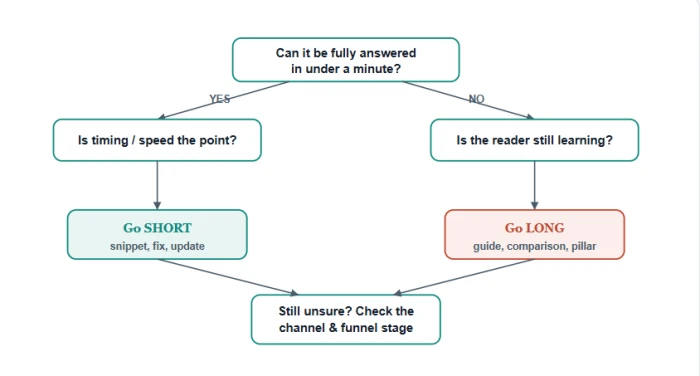
The framework won’t always spit out a clean “short” or “long.” Plenty of topics land in the middle, and that’s fine. The point is to make the call deliberately, from the reader’s situation, instead of defaulting to whatever length you always write.
Running the Framework: Four Real Scenarios
The proof that this works is that it doesn’t give one answer. Feed it four common jobs and watch it point in four directions.
| The job | What the framework sees | Verdict |
| “How to unclog a drain” | Answerable fast, reader wants it now, strong snippet target | Short steps, one image, done |
| “Notion vs Asana for teams” | Genuine comparison, reader is weighing a decision, mid-funnel | Medium-long structured, scannable, with a clear pick |
| A breaking product update | Timing is everything, answer is finite for now | Short first ship fast, expand later if it has legs |
| “Complete guide to sourdough” | Opens into twenty sub-questions, reader is learning, link-worthy | Long the pillar the rest of the topic links to |
Same three questions each time, four different calls because the questions read the situation rather than defaulting to a house style. That’s the entire value of having a framework instead of a preference.
The Hybrid Truth
The framing that pits long against short falls apart the moment you think in systems instead of single posts. The strongest content operations don’t pick a side they use each format to feed the other.
It runs both directions. A deep pillar guide gets broken into a dozen short pieces: a snippet-hunting FAQ answer, a social post, an email tip each pointing back to the source. And those short pieces, doing their small jobs across different channels, build the authority and links that lift the long guide. Long content is the reservoir; short content is the plumbing.
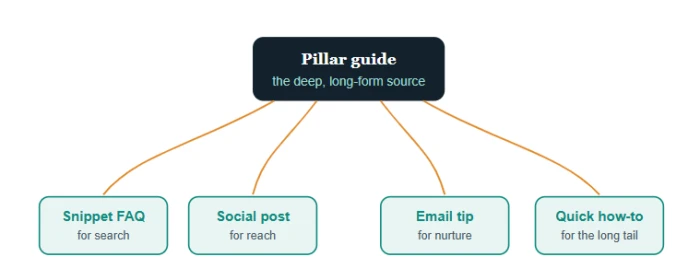
Seen this way, “long vs short” is like arguing whether a tree is the trunk or the branches. It’s both, and each is pointless without the other.
The Hidden Cost of Choosing Wrong
Picking the wrong format isn’t a neutral miss where you simply rank a bit lower. Each format carries a specific tax when it’s applied to the wrong job, and both taxes are easy to overlook until they’ve piled up.
| When You Go Long by Default: The Bloat Tax | When You Go Short by Default: The Shallow Tax |
| Padding buries the actual answer, and readers feel the filler even when they cannot always identify it. | You leave readers with follow-up questions, so they return to search and may choose a deeper page instead. |
| Every long page creates more maintenance work because facts, screenshots, prices, and product details eventually become outdated. | Thin pages have fewer opportunities to earn links, demonstrate expertise, or strengthen the wider site. |
| You may spend three days producing a long article when a focused 500-word answer would have solved the query more clearly and efficiently. | Publishing too many underdeveloped pages on substantial topics can make the site feel shallow and incomplete overall. |
The cost of the wrong call is why the framework matters. This isn’t about optimisation at the margins it’s about not quietly sabotaging good work by forcing it into a length it was never suited to.
Measuring Each One on Its Own Terms
A lot of bad content decisions come from measuring the two formats against identical metrics. Hold a short snippet post to a long guide’s backlink count and it looks like a failure. Hold a pillar guide to a snippet’s time-to-publish and it looks bloated. Both readings are wrong because the yardstick is wrong.
Each format has its own definition of success:
● Judge long-form on depth signals over time: backlinks earned, the spread of long-tail terms it ranks for, sustained engagement, and the assisted conversions it quietly influences months later. Long-form is a slow compounding asset, not a quick hit.
● Judge short-form on velocity and precision: did it capture the snippet, how fast did it publish and get shared, and did it move the one specific action it was built to move. Short-form is a sprinter time with a stopwatch, not a calendar.
Get the yardstick right and the “which wins” debate quietly dissolves, because you stop comparing them at all. You start asking whether each one did its own job.
The Verdict
There is no format that ranks better. There’s only the person who matches length to the job in front of them, and the person who picks a length out of habit and hopes. The first one wins consistently; the second one wins by accident, sometimes, when the habit happens to fit.
So stop asking your content to be long or short as if that were a plan. Read the query’s weight, read where the reader stands, read the channel it’ll live in then let those decide. Some days that’s 300 words. Some days it’s 4,000. Both can be exactly right, and the skill was never picking a side. It was knowing which day you’re having.