Picture the search result you grew up with: ten blue links, maybe an ad at the top. That page is mostly gone. Now the first thing you see is an AI-written answer, with snippets, "people also ask," and video stacked underneath. On a large share of searches, the reader gets what they came for without clicking anything at all.
That changes the job of SEO writing. Visibility no longer means ranking a link. It means two things at once: being found by a person and being quoted by a machine. These ten tips are built for that version of search, not the old one.
Visibility Means Something Different Now
Every page you publish is read by two very different audiences at the same moment. One is a person skimming on a phone, deciding in a second or two whether to stay. The other is a set of systems, Google's crawler and the AI answer engines sitting on top of it, parsing your words for something clean enough to lift into an answer.
Here is the part that trips people up. Those two readers now want almost the same thing. The era of gaming the ranking with keyword density and thin pages is over, because the algorithm reads a lot like a person does. It rewards the page that genuinely answers the question, and it ignores the one that only pretends to.
The numbers show how far this has gone. Google's AI answers now appear on roughly one in six desktop searches and keep spreading, and its conversational AI Mode passed a billion monthly users in 2026, with questions that run about three times longer than a classic search. People are asking more specific things, and the bar for a good answer is rising to meet them.
So the move is not to write for machines. It is to write the genuinely best answer to a real question, then make it easy for both readers to find and lift. The ten tips below follow the order you actually work in.
1. Start From Intent, Not the Keyword
Behind every search is a job the person is trying to finish, and that job, not the string they typed, is what Google and the AI answer layer are really grading you against. Two people can search the same three words and want opposite things.
So the first decision happens before you write anything: which of the four jobs is this query doing, and can your page actually do it? Take "best running shoes for flat feet." That searcher wants to weigh options and pick one, so a history of footwear, however well written, answers a question nobody asked.
| Intent | What they want | The page that wins |
| Informational | To learn or understand | A clear guide, explainer, or definition |
| Commercial | To compare before deciding | A comparison, review, or "best X" roundup |
| Transactional | To do or buy now | A product, signup, or tool page |
| Navigational | To reach a specific place | Your branded or destination page |
Pick a keyword whose intent you can honestly satisfy. The ones you can't will rank for a day, then slide the moment readers bounce straight back to the results.
2. Read the Results Page Before You Draft
The results page is the clearest brief you will ever get, and most writers skip reading it. Whatever sits in the top few spots is Google showing you the shape of answer it currently believes this query deserves.
Search your term and look, honestly, at what is winning. If every top result for "best running shoes for flat feet" is a comparison roundup built around a table, that is not a pattern you out-write with a personal essay. Note the format, and note which features are in play, an AI answer, a snippet box, a video row, because each is a hint about what the reader expects to find.
Then make a call: match that format, or beat it at its own game. What you should not do is decide the shape in a vacuum and hope the engine happens to agree with you.
3. Plan for Depth, Not a Lone Page
A single thin page almost never earns trust on a real topic. Search and AI engines both decide who to rely on by how fully a site covers a subject, which makes depth a planning decision you make before the first draft, not a length you pad your way toward.
It matters more now because of how AI answers get built. Ask an engine something and it quietly runs a handful of related sub-searches, a process called query fan-out, before it stitches a response together. A site that covers the whole territory simply has more places to be found in that sweep. So before you write the headline piece, sketch the territory around it:
● Map the core question first, then the follow-ups a curious reader asks right after it.
● Build one hub page that owns the topic, with supporting pieces that each go deep on a single slice.
● Write for the awkward, specific questions a real practitioner would raise, not just the popular term that brings the traffic.
4. Answer the Question in the First 100 Words
Readers decide whether to stay in a second or two, and AI engines pull their answers from the top of the page, so anything buried under a slow warm-up might as well not be there. Studies of AI citations in 2026 kept turning up the same pattern: pages that answer upfront get quoted far more than pages that make you dig for it.
Lead with a clean, direct answer to the exact question, then open it up underneath with the context, the steps, the nuance. Journalists have called this the inverted pyramid for a century. The only new part is that a machine now enforces it.
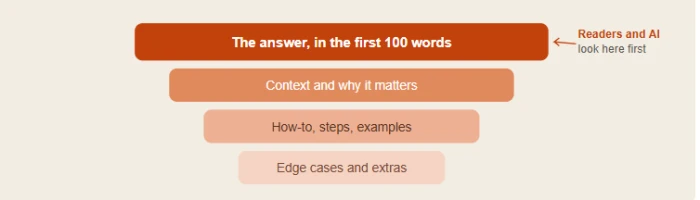
Watch out : Three paragraphs of scene-setting before the point. That preamble is exactly what a reader skims past and an extractor throws away.
5. Structure for Extraction, Not Decoration
Snippets and AI answers are assembled out of clean, self-contained blocks, and AI Overviews tend to lift only around 150 words at a time. That has a quiet consequence: your page has to be built from chunks that each make sense on their own.
Headings do more of this work than people realize. One phrased as the actual question gets pulled far more often than a tidy label, because it matches what somebody typed into the box.
Tidy label : Schema Markup Considerations Real question : How does schema markup affect AI Overviews? |
Keep each section tight, with the answer sitting directly beneath its heading. Reach for a list when you are walking through steps, and a table when two things are genuinely worth setting side by side. Both get lifted cleanly. A wall of text under a pretty heading gets ignored by the skimmer and the machine alike.
6. Write Naturally, Then Fit the Keyword In
Write the sentence a knowledgeable person would actually say out loud, and worry about the keyword second. Search reads meaning, synonyms and context now, so repeating an exact phrase five times reads as spam to the algorithm and the human in equal measure.
You can feel the difference immediately. "Our dog grooming service offers dog grooming for all your dog grooming needs" is what writing-for-the-robot sounds like. "We groom dogs of every size, from nervous puppies to the old regulars" says more, ranks at least as well, and sounds like a person wrote it.
Draft as if you were explaining it to one person who asked, then check that the core term and its natural cousins are present where they fit. The moment a sentence bends around a phrase and stops sounding human, you have lost on both fronts at once.
7. Put First-Hand Experience on the Page
Fluent text is free now. The one thing a model cannot manufacture is having actually done the thing, which is exactly why the "experience" at the front of Google's E-E-A-T has quietly become the differentiator, and why an answer engine reaches for a page that has it.
The test is blunt: if an AI could write your page without ever needing to cite you, you have given it no reason to. Specificity is what changes that, and it usually takes one of three forms.
● A detail only someone who has done it would know, the kind that never shows up in a generic summary.
● Your own numbers, tests and results, in place of the same industry stat every competing page already quotes.
● A clear opinion, stated plainly, instead of every sentence hedged into something nobody could possibly disagree with.
Watch out : Competent, sourceless writing that reads like a model's first draft. It gives neither a reader nor an AI engine any reason to choose it over the dozen pages exactly like it.
8. Write Blocks That Are Easy to Quote
Earning a snippet or an AI citation comes down to how easy you make the lift. Roughly three in four pages cited in AI answers still rank in the top ten, so ranking has not stopped mattering, but between two strong pages, the one with the cleaner pull-quote wins.
So write each answer as if someone might paste it somewhere with none of the surrounding page attached. Open a definition with the term and a complete one-sentence answer, then expand from there.
Needs context : It depends on a few things we covered above, but generally, yes. Stands alone : Generative engine optimization is the practice of structuring content so AI systems can retrieve and cite it reliably. |
If a passage only makes sense once you have read the three paragraphs around it, it will not travel, because that surrounding context is the first thing an extractor drops on the floor.
9. Use Internal Links as a Map
Internal links do two jobs at once. They show readers how your ideas connect, and they show crawlers and AI engines the shape of your site, including which page you consider the definitive one on a subject.
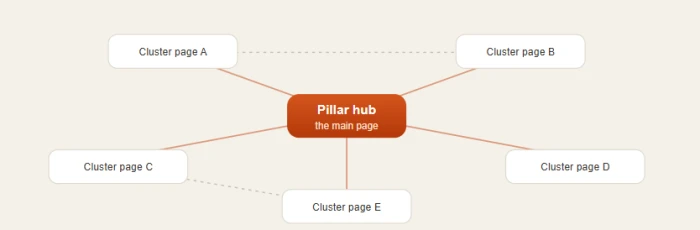
The pattern that works is unglamorous. Point your supporting pages at the hub, link the hub back out to each of them, and connect related pieces wherever it genuinely helps someone go a step deeper. Describe the destination in the anchor text while you are at it, since "click here" and a bare URL tell a crawler nothing about what sits on the other side.
The failure mode is just as quiet: orphan pages that nothing points to tend to sit unseen, however good they happen to be.
10. Treat Publishing as the Start, Not the Finish
Content decays. A page that was the best answer two years ago slips a little every month as the facts shift and sharper pages appear, and freshness genuinely counts, especially for AI answers, which 2026 analyses found skew noticeably more recent than ordinary results.
The useful news is that you can finally watch it happen. In 2026 Google added a Search Console report for how you show up in AI Overviews and AI Mode, so AI visibility stopped being a guessing game. Three habits keep a library alive rather than quietly sinking:
● Put your important pages on a refresh schedule, updating the facts, dates and examples before they age out.
● Prune or merge the thin posts that dilute a topic instead of strengthening it.
● Read the AI-visibility report next to your classic rankings, so you know where you are being cited and not only where you place.
The Last Word : It's All One Move
Strip away the tactics and all ten tips are the same instinct wearing different clothes. Be the genuinely best answer to a real question, then make that answer effortless for a person to read and a machine to quote.
Write the best answer. Structure it to be lifted. Keep it the best answer. Pick one page that matters and run it through this list this week, starting with the first hundred words. The two readers you write for have never agreed more on what good looks like. Your job is simply to give them both the same thing.